
LingoAI Team Report: Localized Deployment Test on an 8GB M1 iMac
By LingoAI Tech February 27, 2026
Introduction: As the global explosion of OpenClaw AI Agents reshapes our digital landscape, a new fever has gripped the industry. Speculators are already racing to coin the next buzzword, labeling AI-driven decentralized networks as “Web4.” OpenClaw rejects the “Web4” gimmick; those who abuse the concept do not truly understand Web3.0, nor do they realize that OpenClaw is actually the real-world incarnation of “Charlie” and “MetaLife” — concepts long envisioned by the creators of Web3.0.
While most users are immersed in the convenience of calling centralized APIs, they may not realize that the continuous leakage of privacy and secrets is planting massive hidden dangers for the future. Through an experiment on an 8GB RAM M1 iMac, LingoAI proves: to protect privacy sovereignty and resist digital colonialism, the only path is to return AI completely to the edge.
I. Origins: Reclaiming the AI-Native Gene of Web3.0
The “Web4” label implies that AI is an afterthought to decentralization. The history of Web3.0 proves the opposite:
l The 2003 Vision: When LingoAI Co-founder Henry Wang first proposed the term “Web3.0,” the core definition was the intersection of AI and social networking. This means Web3.0 has had AI-Native DNA since its inception.
l The 2006 Resonance: Sir Tim Berners-Lee, the father of the World Wide Web and a Turing Award winner, formally introduced decentralization into the Web3.0 concept. While many mistake Web3.0 for mere blockchain and cryptocurrency, its true bedrock is Machine-readable Data and User Data Ownership.
l The Grant Unified Logic Without machine-readable structured data, AI has no nourishment; without decentralized protocols, AI Agents remain nothing more than expensive plugins for centralized giants. OpenClaw and Agent networks are not “Web4” — they are the final pieces of the The Grant Unified Theory of Web3.0. In Henry Wang’s framework, true Web3.0 is the deep fusion of Data 3.0 (Decentralized Data) and Finance 3.0 (Decentralized Finance).
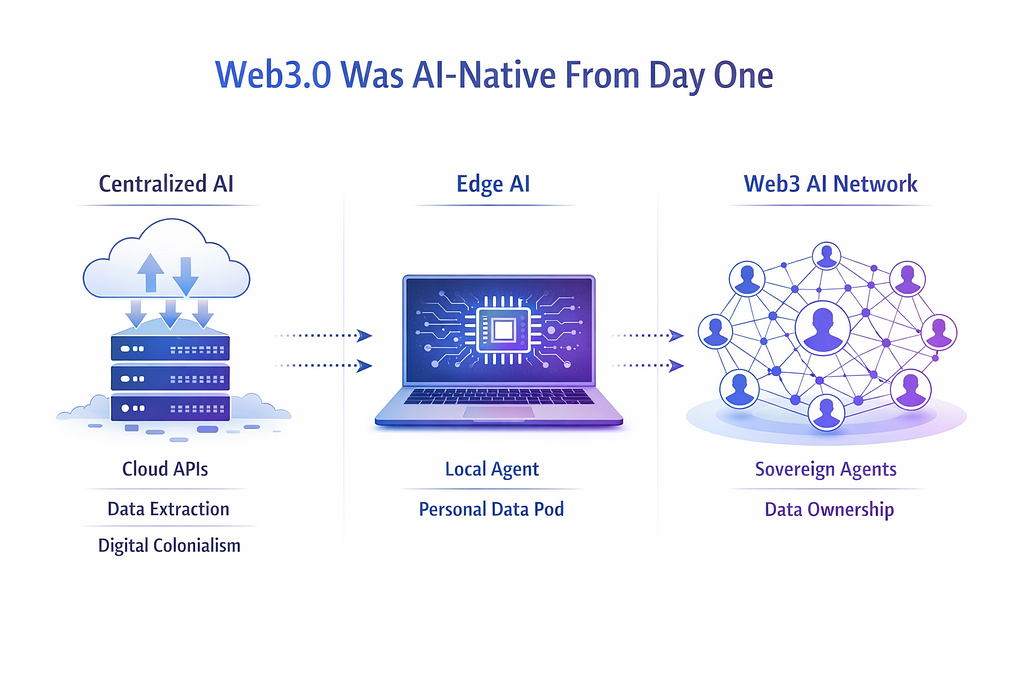
II. A Warning: API Cracks and Digital Colonialism
The current status quo is alarming: the vast majority of OpenClaw users are currently calling centralized APIs (like OpenAI or Claude) using their most sensitive, private, or confidential data — emails, financial records, health data, and confidential corporate strategies.
l Privacy Leaks: While you believe you are building an “autonomous agent,” you are actually funneling personal preferences and core business logic to one or a few tech giants.
l Digital Colonialism: This data extraction to Global Majority is essentially a new form of “Digital Colonialism.”
l Data and AI Sovereignty: LingoAI and MetaLife are committed to On-device AI. We are working closely with chip giants like Qualcomm. Despite the competition between Apple and Qualcomm, both agree on a fundamental ARM-based premise: using powerful on-device GPU or NPUs to liberate AI from cloud control, keeping data within the boundaries of sovereignty.
III. The “Charlie” Vision and the Ontological Bedrock
To understand the inevitability of edge-side AI, we must revisit the “Charlie” vision that Sir Tim Berners-Lee has been refining for two decades:
l Semantic Web & Ontology: Sir Tim’s invention of “Ontology” is the cornerstone of modern AI knowledge graphs and logical reasoning. Without structured data, LLMs cannot accurately understand intent or drive Agents to execute tasks.
l Incubating the Soul (1999–2001): Sir Tim first described software agents that could automatically handle mundane tasks.
l The Birth of a Name (Circa 2006): He named this assistant “Charlie” and used the AI-Native concept of Web3.0 to represent the next generation of the internet. The reason for this convergence was simple: the Semantic Web alone could not break down data silos; only decentralization could create a true “Web of Data.”
l Design Intent: Sir Tim emphasized that Charlie must run within the user’s Personal Pods, working with personal data without ever leaking it to third parties.
IV. Stress Test: Data & AI Sovereignty on an 8GB M1 Chip
To prove that Web3.0 inclusivity and Sovereign AI are not “castles in the air,” the LingoAI team performed a limit-test on an Apple M1 chip with only 8GB of RAM.
l Zero Cloud Reliance: Built on the Ollama + Qwen 2.5 (1.5B/7B) architecture, running entirely in a local environment.
l Overcoming Technical Gaps: We successfully bypassed the configuration file signature verification of the OpenClaw 2026 Preview and manually injected the ollama-local path by modifying the underlying openclaw.json.
l Performance Miracle: Leveraging the M1’s Neural Engine and Unified Memory Architecture (UMA), we achieved closed-loop execution without data leaving the device — even at the memory’s breaking point.
l Dignity for the Global South: This proves that Web3.0 does not require expensive “compute hegemony.” It can happen on an average person’s device. AI should not be a monopoly of centralized tech giants; it is the inherent dignity of every sovereign individual.
V. Conclusion: Execution Over Buzzwords
In 2001, Sir Tim gave the Agent a soul. In 2006, he named that soul Charlie. In 2026, LingoAI, through OpenClaw, has finally allowed Charlie to achieve “spiritual homecoming” on local hardware.
As LingoAI and Singapore IGF Co-founder Una Wang stated: “This is the true geek spirit. LingoAI has set a benchmark for personal AI sovereignty.” When you use private data to call cloud APIs, you are selling your soul; when you run a local Agent, you are defending your freedom.
True Web3.0 is the deep integration of Data 3.0 and Finance 3.0. Instead of hiding behind the hype of “Web4,” join LingoAI in returning to the original vision. Now that local execution is solved, the next question is: How do we connect these scattered sovereign agents into a life-network that transcends biological boundaries?
Stay tuned for LingoAI Deep Series (Part II): “OpenClaw, MetaLife, and the Evolution of Human Digital Life.”
About LingoAI:
LingoAI is an user-owned data infrastructure reshaping how data is owned, shared, and monetized. Our mission is to empower communities, especially the Global Majority to contribute, control, and benefit from their data and make all languages accessible.
We built on social linked data and the MetaLife.Social semantic web layer, we separate users’ data from applications, enabling interoperable, privacy-first intelligence. We make it easy to collect, label, and exchange local-language content through decentralized data market place and multilingual AI hub, closing the digital divide and supporting language preservation. Contributors receive on-chain incentives when their data powers multilingual AI agents, creating real-world utility and sustainable data economic value.
Please check the link below to learn more information:
Telegram: https://t.me/lingoaitech
Website: https://lingoai.io/
TG Mini App: https://t.me/LingoAI_tmaBot
Discord: https://discord.gg/tvncJ9YTpW
LinkedIn: https://www.linkedin.com/company/lingoaitechnology/
Facebook: https://www.facebook.com/lingoai.aigc/
LingoCrowd: https://crd.lingoai.io/